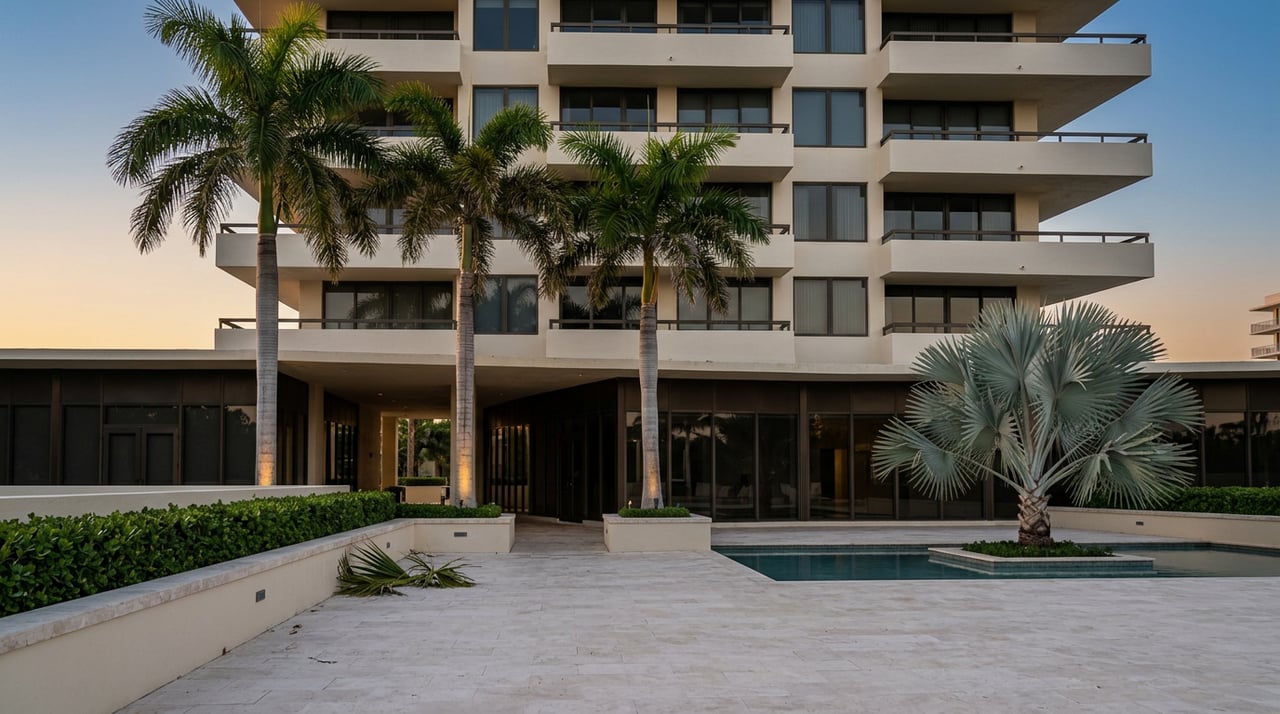
In June 2024, Eugene and Debbie Friedlander closed on a $3.65 million oceanfront unit at Toscana South in Highland Beach. Five months later, a notice arrived: $91,595 due, their share of a $7 million elevator replacement project the association's board had already discussed in a meeting on February 28 that year, three months before the couple ever signed a contract. The sales agreement had included a standard representation that the seller was not aware of any pending assessment. The Friedlanders are now suing in Palm Beach County Circuit Court, arguing that representation was false.
Whatever the court decides about the seller's knowledge, the case is a clean illustration of a problem that has nothing to do with fraud and everything to do with timing. The information the Friedlanders needed existed for months before they closed. It sat in board minutes, in a general manager's notice to owners, in an agenda item anyone could have asked to see. It just wasn't asked for early enough to matter.
For anyone shopping a Highland Beach condo right now, that timing gap is the actual lesson. Not "check the reserve study," which every guide to Florida condo buying already tells you. The more useful version is narrower and less obvious: the compliance paperwork the state now requires wouldn't have caught this assessment at all, and knowing why changes what you ask for before you ever write an offer.
What a Clean Compliance Report Doesn't Cover
Florida's post-Surfside reforms, first passed as SB 4-D in 2022 and revised twice since, require condo buildings three stories or taller to complete a Structural Integrity Reserve Study covering eight specific categories: roof, load-bearing structure, fireproofing and fire protection, plumbing, electrical, waterproofing and exterior painting, windows and exterior doors, and any other item over roughly $25,675 whose failure would affect one of those seven. Elevators are not automatically one of the eight. Unless a board's engineer decides a building's elevator system rises to that catch-all category, it can sit entirely outside the mandated reserve funding the SIRS law was built to guarantee.
Toscana Towers was completed in 2000. Court filings describe the elevators as over 20 years old, with the manufacturer warning that parts were becoming obsolete. That is an ordinary mechanical end-of-life problem, the kind every high-rise eventually faces regardless of how clean its structural inspection comes back. A buyer who requests only the milestone inspection report and the SIRS, the two documents the new law makes mandatory, could walk away from that review with a completely clean bill of health and still inherit a six-figure elevator assessment a few months later.
Highland Beach Moved First, and Its Rule Is Stricter
The town's own building recertification program predates the state law it now runs alongside. On November 16, 2021, the Highland Beach Town Commission unanimously passed Ordinance 2021-011, requiring recertification for existing buildings, six months before SB 4-D took effect statewide in May 2022. The town later refined the program under Ordinance 2022-008.
The local rule is tighter than the state default. Under Highland Beach's own recertification schedule, buildings 25 years or older must recertify every 10 years, matching the state's baseline. Past 40 years old, the town requires recertification every seven years instead. For a barrier island town with a large stock of towers built in the 1970s and 1980s, that shorter cycle means more frequent structural review, and more frequent occasions for a board to discover something that needs fixing sooner than a five-year-old reserve study assumed.
Why This Fall Matters Specifically
The statewide SIRS deadline for most owner-controlled associations was December 31, 2025. Associations that also have a milestone inspection due by December 31, 2026 were given an extension to complete both studies together by that later date. That means boards across Highland Beach are finishing exactly this kind of capital planning right now, with less than four months left before that deadline, deciding in real time whether next year's buyers get a manageable line item or a Toscana-sized notice.
The building stock here makes that decision consequential for more owners than it would in a newer market. A 2021 analysis by The Coastal Star, conducted in the months after the Surfside collapse, found that among the barrier-island towns from South Palm Beach to Boca Raton, Highland Beach had 16 oceanfront buildings that were 40 years or older and three stories or taller, the second-highest concentration in the region behind only Boca Raton's 18. Buildings don't get younger, so that stock has only aged further since. A large share of the town's condo inventory is old enough to fall under the seven-year recertification cycle, and old enough that mechanical systems like elevators, installed decades ago, are approaching replacement regardless of what the structural inspection finds.
Two Boards, Two Outcomes
Not every Highland Beach building is heading toward a surprise. The difference often comes down to whether a board treated its reserve obligations as real money to set aside years in advance, or as a line item to defer.
| Building | What happened | Why it mattered |
|---|---|---|
| Toscana South | Board approved a $7 million elevator project in February 2024; a unit sold in June 2024 without the pending assessment disclosed to the buyer | Buyer inherited a $91,595 bill five months after closing and is now suing the seller |
| The Coronado | In 2023, the building's insurer raised its premium from $1.5 million to $1.9 million, then dropped coverage entirely, giving the board 30 days to find new coverage | Board president Jason Chudnofsky attributed the manageable outcome to years of prior reserve funding rather than a last-minute scramble |
Neither building did anything unusual by Highland Beach standards. One had years of savings absorbing a shock. The other had a capital project that was already public knowledge inside the association but never made it into a buyer's hands before closing.
What to Request, and When
Florida law gives buyers the right to a resale certificate itemizing assessments, but that document typically surfaces during the ten-business-day estoppel window after a contract is signed, not before. By the Friedlander timeline, the board had already discussed the assessment three months before closing. A ten-day window after signing would have arrived too late to change the outcome.
The more useful sequence starts before you write an offer at all. Ask your agent to request:
- The most recent milestone inspection report, Phase 1 and Phase 2 if applicable
- The current Structural Integrity Reserve Study
- Board meeting minutes from the preceding 12 months, not summarized, the actual minutes
- Any capital plan or reserve schedule covering non-SIRS mechanical systems: elevators, garage equipment, air handlers, common-area finishes
- The association's most recent insurance renewal notice, since a non-renewal or premium spike is often the earliest public signal that a building's condition is under scrutiny
None of this replaces the estoppel certificate you'll eventually receive under contract. It gets you the same information three or four months earlier, which is exactly the gap that mattered in the Toscana case.
FAQ
What's the difference between a milestone inspection and a SIRS? A milestone inspection is a one-time structural safety check performed at a building's 25 or 30-year mark, and every 10 years after. A Structural Integrity Reserve Study is a financial planning document that projects how much an association needs to save for eight specific structural components. Buildings often complete both around the same time, but they answer different questions: one is about safety, the other about money.
Does a clean milestone inspection mean no assessment is coming? Not necessarily. The inspection and the SIRS cover structural components defined by state statute. Mechanical systems like elevators can require major capital outlays that fall outside that mandated list entirely, as the Toscana case shows.
Who's responsible for an assessment discovered after closing? It depends on what the purchase contract says and what the seller knew and disclosed. Florida's standard condo rider typically requires sellers to disclose known pending assessments, and a false representation on that point can become the basis for a legal claim, as it has in the Friedlander suit. The cleanest way to avoid that dispute is to have the answer before you're under contract, not after.
Buying an oceanfront condo in a town where the building stock and the compliance calendar are both this active rewards a buyer who asks for the full paper trail early, not just the two documents state law now requires. If you're weighing a Highland Beach purchase and want a second set of eyes on what a specific building's board minutes and reserve position actually say, BlackLabel Luxury Real Estate can help you read the file before you write the offer, not after.